Showing posts with label Ewa Plains Corridor. Show all posts

Thursday, November 7, 2013

Honoring Major John A. Hughes, USMC (Ret.), Combat Pilot and Ewa Field – Pearl Harbor Attack Survivor

Honoring Major John A. Hughes, USMC (Ret.), Combat Pilot and Ewa Field – Pearl Harbor Attack Survivor


The Honolulu City Council Honored John Hughes with an Honorary Certificate of Appreciation for his US Marine Corps service in WW-II and Korea and for his personal heroism on December 7, 1941, where he is seen in a famous photograph firing a 1903 Springfield rifle at attacking Japanese dive bombers during the attack on Ewa Field.

Below is the text of that certificate of appreciation:


Honoring Major John A. Hughes, USMC (Ret.), Combat Pilot and Ewa Field – Pearl Harbor Attack Survivor


On the fateful early morning of December 7, 1941, U.S. Marine Corps Sergeant John Hughes was ready for a quiet Sunday when he looked up to see approaching planes heading straight for the Ewa Mooring Mast Field, home of Marine Air Group 21.
As the planes got close they opened fire and Hughes saw the red ball insignia that immediately told him they were Japanese aircraft, and he quickly headed to the armory for a rifle and ammunition. During the attacks on the airfield, most of the Marine aircraft were destroyed by Japanese attackers with four Marines killed and numerous more wounded.
One of the most famous photos taken during the entire Imperial Japanese air attack on Oahu is of Sergeant John Hughes firing his 1903 Springfield bolt action rifle at attacking Japanese planes. This indelible image has become the iconic symbol of Ewa Field on December 7th.
John A. Hughes was born February 6, 1919 in Rivera, CA and raised in San Fernando Valley. A graduate of San Fernando High School in 1937, in May, 1938 he enlisted in the U.S. Marine Corps in San Diego, CA. After boot camp he was transferred to Marine Aviation at North Island, San Diego, as an Aircraft Engine Overhaul Mechanic.
In January 1941, Marine Air Group 21 sailed to Hawaii, and located at former Navy Mooring Mast Field, Ewa, Oahu. Marines built a tent camp for about 600 personnel after clearing hundreds of large sisal plants from a rough ancient coral reef landscape. They lived in tents until October when a Naval Construction Battalion built Quonset huts.
MAG-21 operated during this time without major events until December 7, 1941. Four fellow Marines were killed, 33 airplanes destroyed, 14 damaged.
In February 1942, while at Ford Island helping repair aircraft damaged on a raid to the Marshall Gilberts, John Hughes received orders to Pensacola, Florida for flight training which he completed in December of that year. Transferred to Mojave, California, in March 1943 he was ordered to Espirito Santo, Southern Pacific, where he was assigned to VMSB 132 as a dive bomber pilot.
In June 1943 to April 1944 he participated in combat dive bombing missions in New Georgia, Bougainville, New Britain Campaigns, and in November 1944 was transferred to the Solomon Islands for assignment to VMSB 243 at Luzon, Philippine Islands where he was engaged in the Northern Luzon and Southern Mindanao Campaigns doing close air support for Army Troops. On September 1, 1945, the Pacific War was over and he returned to the “states”, at El Toro, California.
In November 1946 John Hughes married Mary Duba from Libertyville, Illinois, and in was then transferred to a squadron in China for observation and transport missions. In August 1948 he returned to a much larger MCAS Ewa Field as a Material Officer.
In January 1949 he was assigned to Cherry Point, NC, and flew F4U Corsairs and the F2H Banshee jet aircraft. In November 1951, John Hughes attended helicopter school, in Quantico Virginia and in May 1952 was sent to Korea, assigned to VMO 6 performing helicopter medical evacuation missions before being transferred back in March 1953 to El Toro, Ca.
In January 1954 to May 1954 he served aboard the USS Bairoko during Bikini atoll H-bomb tests and then in September, 1956 to September, 1960 he was stationed at the Bureau of Aeronautics, Washington, D.C. as the Head, Rotary Wing Section Maintenance Division.
In October 1960, he transferred to the MCAS in Okinawa, as an Airfield Operations Officer. His final tour was back to El Toro, CA for helicopter duty during December 1961 to June 1964  before retiring from the U.S. Marine Corps.
Completing 150 Missions, Major John Hughes was awarded the Distinguished Flying Cross, Air Medal, Letter of Commendation, Good Conduct Medal, American Defense, China Service, Asiatic Pacific Campaign, American Campaign, Victory WWII, Philippine Liberation, Korean Service, United Nations Korean Service, National Defense, Distinguished Pistol Shot, Distinguished Rifleman, Presidential Unit Citation, Navy Unit Citation.
We proudly and gratefully honor the historic and courageous service of John A. Hughes to our islands and to our nation.
Semper Fi.


Friday, October 4, 2013

Did Dec. 7, 1941 Pearl Harbor Attack Architect Isoroku Yamamoto Tour Hawaii Military Bases In 1933?

Did Dec. 7, 1941 Pearl Harbor Attack Architect Isoroku Yamamoto Tour Hawaii Military Bases In 1933?

By John Bond - Save Ewa Field
 
 
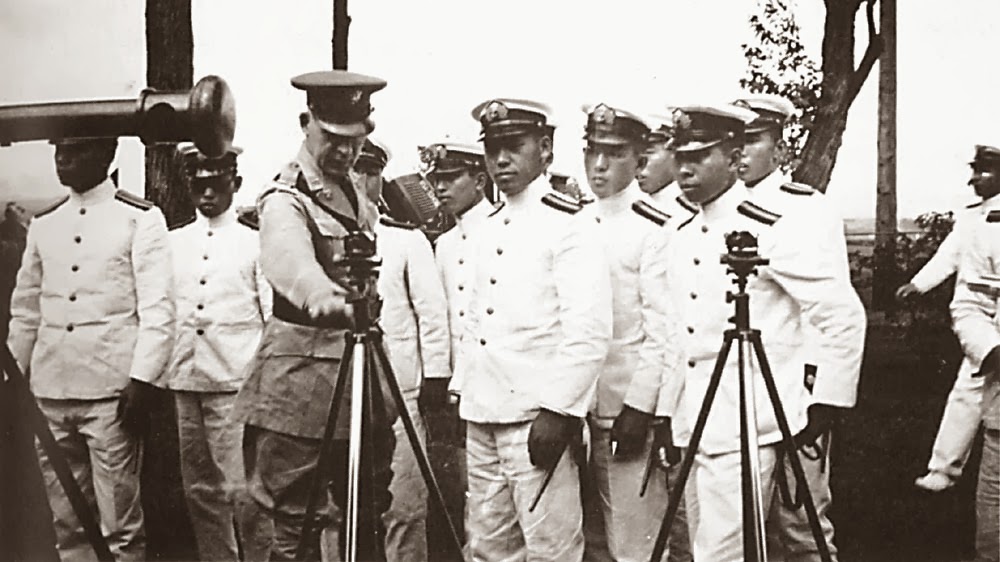
In 1933 there was an exhibition event on the island of Oahu known as a gymkhana ("a multi-game equestrian event to display the training and talents of horses and their riders") which was held at the major US Army base of Schofield Barracks.
 
In 1933 horses (and mules) still played a major role in Army field operations, -cavalry, towing artillery, recon, etc.
 
Based upon analysis of a 1933 photo showing Imperial Japanese Naval officers visiting this event and being shown a transit device (theodolite?) there is an IJN officer in the center of the photo who shows a remarkable resemblance to Isoroku Yamamoto.


A study of a later picture of Admiral Yamamoto shows nearly identical facial features- ear, nose, chin, lips, etc.
 
I have for years always thought this WAS a picture of Yamamoto in Hawaii but didn't have any resources to search it further. Currently I am having this checked out to see if my facial analysis is correct.
 
However, his history says he would have been a Rear Admiral by 1933 and 49 years old.
 
I don't yet know if this is what his rank is in this photo, but the face and the forward personal bearing of this individual sure does indicate a leader and someone very comfortable in the presence of a US military officer.
 
 
Where was Isoroku Yamamato in 1933?
 
"From 1919-1921 he studied at Harvard University. Promoted to Commander upon his return to Japan he taught at the staff college before being sent to the new air-training center at Kasumigaura in 1924 to direct it and to learn to fly.
 
From 1926 to 1928, he was naval attache to the Japanese embassy in Washington. He was then appointed to the Naval Affairs bureau and made Rear Admiral, he attended the London Naval Conference in 1930. Back to Japan he joined the Naval Aviation bureau and from 1933 headed the bureau and directed the entire navy air program."
 
Could this have been Yamamoto in Hawaii?
 
It would have been very much like Yamamoto to have been very interested in Hawaii and especially the island of Oahu and the layout of its military bases. If this IS Yamamoto in Hawaii - there is even more to this Pearl Harbor chapter that isn't yet fully known.
 
We shall see where this leads!

More Photos:


The date on this photo is February 7, 1935, Hawaiian Division Staff
 
 
Footnotes:
 
 
"Isoroku Yamamoto was born in 1884. Yamamoto graduated from the Japanese Naval Academy in 1904. He fought in the Battle of Tsushima Straits in May 1905 where Yamamoto lost two fingers on his left hand. "
 
Because most of these IJN officers appear to be wearing gloves, this key clue as to whether this is Yamamoto or not is not discernible.
 
While he had served in America, Yamamoto developed a negative attitude to the American Navy and the standards he had witnessed within it. He described the American Navy as a club for golfers and bridge players. However, for all this disdain, Yamamoto was aware of the vast power that the US Navy had - especially in the Pacific.
 
 
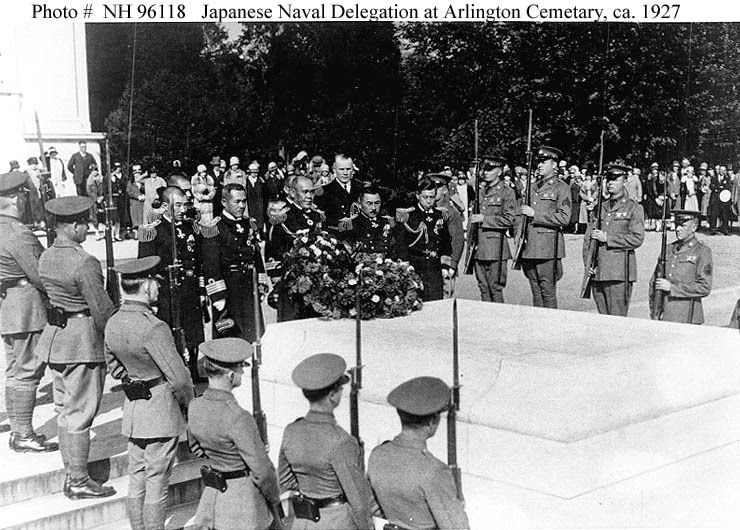
CAPTION: "Japanese Vice Admiral Osami Nagano lays a wreath at the tomb, circa 1927. At the right end of the Japanese delegation is the Naval Attache to the United States, Captain Isoroku Yamamoto."
 
Throughout his career, Yamamoto had opposed many of Japan's military adventures, such as the invasion of Manchuria and the ongoing war with China.
 
In addition, he was vocal in his opposition to any war with the United States, and delivered the official apology for the sinking of USS Panay in 1937.
 
These stances made the admiral very unpopular with the pro-war factions in Japan, many of which put bounties on his head.
 
On August 30, 1939, Navy Minister Admiral Yonai Mitsumasa promoted Yamamoto to commander-in-chief of the Combined Fleet commenting, "It was the only way to save his life - send him off to sea."


On the evening of Jan. 30, 1933, Adolf Hitler, the newly appointed Chancellor of Germany, stood in a government building at an open window watching a torchlight parade of 25,000 Nazi troops march through the streets of Berlin. Thousands of Germans cheered as they marched by, and Hitler was giddy with delight. "No power on Earth will get me out of here alive."


Thursday, September 5, 2013

Ewa Corridor- Most Important, Least Documented Aspect of Dec. 7, 1941 Pearl Harbor Attack

Ewa Corridor- Most Important, Least Documented Aspect of Dec. 7, 1941 Pearl Harbor Attack

How military forces choose their attack-invasion route is extremely important.
This is why from a Japanese Naval Military point of view for the planning of the air attack on Pearl Harbor, the main attack force would advance and retreat through the Ewa Plains Corridor.
The corridor through Ewa offered the best possible Pearl Harbor entrance and exit route and ideal VFR (visual flight) navigation aids, especially if heavy clouds or heavy rain storms had been encountered over Oahu that morning.
Once the confusion of battle and heavy AA fire began, it was also very important to have key landmarks memorized by Japanese pilots, and the Ewa Plains route was ideal as it offered clear visual markers to take them in and back out of the primary attack area.
Inbound and outbound Japanese planes could count on a series of explicit visual markers in a sea of green sugar cane fields and Kiawe trees- Barbers Point light house, the OR&L tracks, Fort Barrette, Ewa Plantation twin mill stacks, Ewa Field, and then West Loch with a clear view of all the ships moored around Ford island.
On return from bombing US Navy fleet ships at Pearl Harbor, eye-witnesses saw the Japanese dive bombers pivot around the Waipahu Mill stacks like an air race pylon, and then head straight out to Ewa's twin mill stacks to circle around Ewa Field looking for strafing targets.
Most of Ewa Field's planes were already set on fire by the initial Japanese Zero attack, so Val dive bombers still well armed with 7.7 mm ammunition began attacking privately owned Marine vehicles and anyone or anything on the airfield that looked like a good target- such a the base fire truck and ambulance, which was especially riddled with bullet holes. 
After strafing the Ewa Field area and nearby Ewa Plantation Mill buildings, and waving to gathered Ewa Villagers watching the attack from their homes, the various Japanese planes headed straight for the Barbers Point light house and then out to sea off shore.
A few miles out and safe from AA fire, as well as protected by a screen of Zero fighters, the planes gathered in a large circular formation and then headed back to the Japanese aircraft carriers north of Oahu.
The Ewa Corridor was the key attack and exit route for Japanese Naval Air Forces on December 7, 1941, yet the Ewa Plains Corridor and Ewa air and ground battlefield is the least known aspect of the Dec. 7, 1941 attack on Pearl Harbor.

John Bond
Save Ewa Field

Ewa Plains Battlefield Nomination Document and Battlefield News Archive Available

Previous MCAS Ewa and Battlefield Blog Posts Can Be Found On These Links: